Why Guest Houses Over Hotels – Authentic, Affordable Choice

Updated: May 15

Finding that perfect balance between comfort, value, and genuine welcome can feel tough when booking a stay in Elgin, Scotland. Many travellers want more than a standard room—they want a warm greeting, local insight, and the kind of homely details that hotels so often miss. Understanding the real meaning behind guest houses and challenging common myths helps you discover a more personal and authentic experience that connects you to Elgin’s community at a price that works for your budget.
Table of Contents
Key Takeaways
Point | Details |
Personal Connection | Guest houses offer a personal touch and local insights that standard hotels often lack, enhancing the overall travel experience. |
Diverse Options | Various types of guest houses cater to different traveller needs, from family-run to boutique options, each providing unique experiences. |
Cost Effectiveness | Guest houses generally offer lower rates than hotels for comparable quality, often including extras like breakfast and personalised service. |
Community Impact | Staying in a guest house supports the local economy and promotes environmentally sustainable practices, benefiting the community of Elgin. |
Defining Guest Houses and Common Myths
Guest houses occupy an interesting space in the accommodation world. Unlike hotels with their standardised rooms, corporate structures, and formal check-in procedures, guest houses are typically smaller, privately owned properties that offer a more personal experience. The term itself remains somewhat fluid because guesthouses function as an alternative accommodation type without strict regulatory definitions across different regions. In Elgin and across Scotland, you’ll find everything from Victorian terraced houses converted into guest accommodation to purpose-built properties with just four or five rooms. What unites them is this core principle: they prioritise personal connection over profit maximisation, though they absolutely remain commercial enterprises.
Now for the myths. The biggest one? That guest houses are somehow inferior to hotels because they lack “professional” service. This misses the point entirely. Hotels operate on a commercial hospitality model where transactions are purely transactional. Guest houses, by contrast, often embody genuine hospitableness as a social practice that goes beyond standard service protocols. Your host might recommend their favourite local pub because they actually know it, not because they’ve been trained to suggest it. That’s not less professional. That’s different. Another common misconception is that guest houses are budget options because owners cut corners. Actually, owners simply allocate resources differently. You might not have daily housekeeping, but you gain a communal breakfast where you meet other travellers and locals. You won’t find a minibar, but you’ll discover genuine local knowledge that guidebooks miss. The final myth worth addressing: that guest houses lack amenities. Modern guest houses in Elgin offer en-suite bathrooms, heating, WiFi, and quality bedding as standard. The distinction isn’t about comfort level but about the experience philosophy.
Understanding these definitions and dispelling myths matters because it helps you choose accommodation that actually aligns with what you value. If you’re seeking efficiency and anonymity, a hotel works perfectly. If you’re after authenticity, local insight, and genuine human interaction at a better price point, a guest house delivers exactly that. When comparing your options during booking, you’re not choosing between “basic” and “better.” You’re choosing between two different hospitality philosophies, each with distinct advantages.
Pro tip: When researching guest houses online, read reviews specifically mentioning host interactions and local recommendations rather than focusing solely on room ratings, as this reveals whether the property matches the authentic experience you’re seeking.
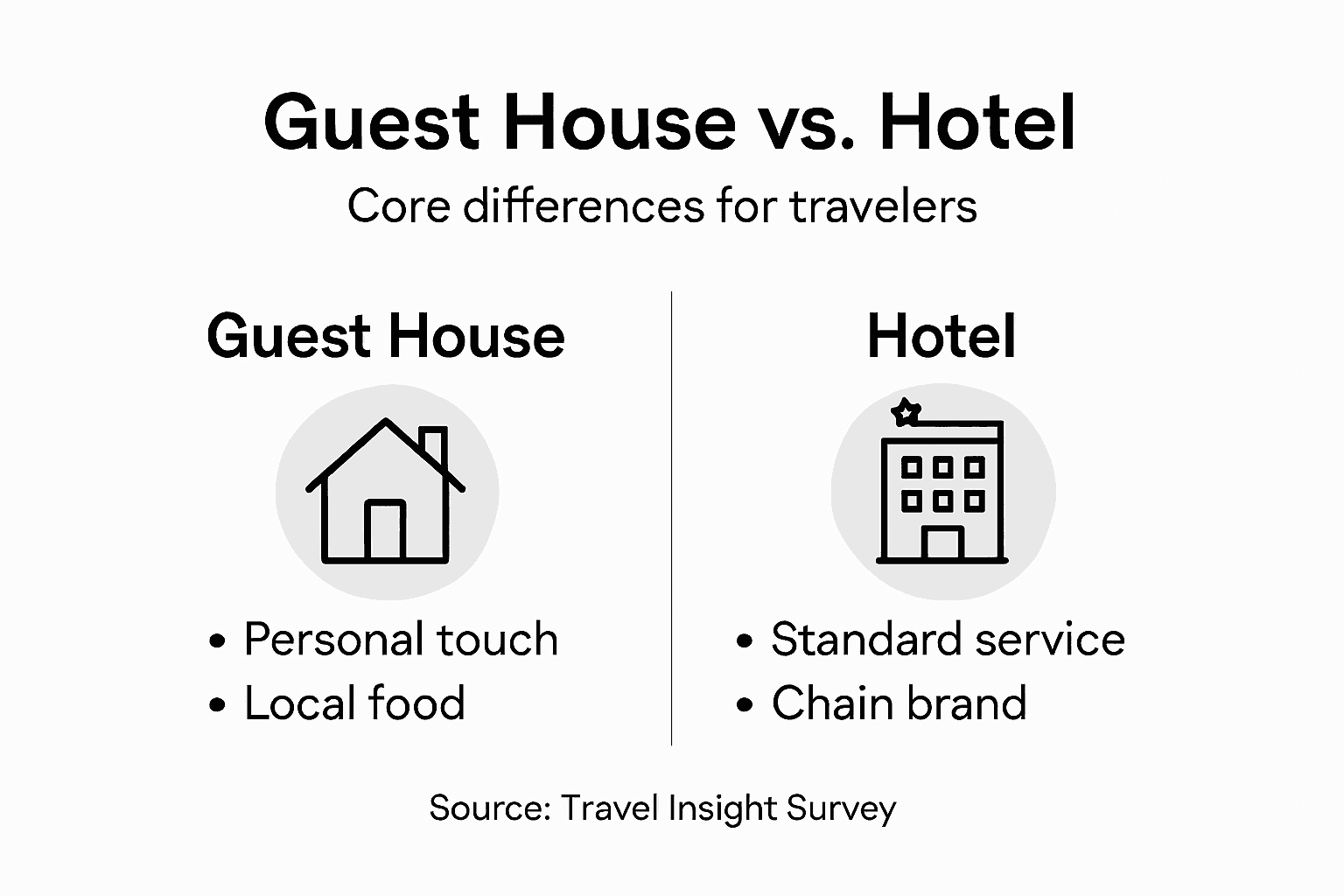
Here’s how guest houses and hotels differ in key hospitality aspects:
Aspect | Guest House Experience | Hotel Experience |
Room Personalisation | Individually decorated rooms | Uniform, standardised interiors |
Host Interaction | Direct, friendly communication | Formal, often limited contact |
Local Knowledge | Personalised recommendations | Generic guidebook suggestions |
Breakfast | Homemade, communal setting | Buffet, impersonal service |
Booking Flexibility | Case-by-case adjustments | Fixed formal policies |
Impact on Community | Supports local economy directly | Profits often leave the region |
Types of Guest Houses in Elgin and Beyond
Guest houses are far from a one-size-fits-all accommodation option. The spectrum runs wide, and understanding the different types helps you find exactly what suits your visit to Elgin. At one end, you’ll discover family-run guesthouses where the owner lives on-site and treats guests like houseguests rather than customers. These properties typically have five to ten rooms, and the owner’s personality shapes the entire experience. At the other end sit boutique guesthouses, smaller luxury establishments with individually designed rooms, premium bedding, and thoughtful touches like complimentary refreshments or afternoon tea. Between these poles, you’ll find traditional guesthouses that operate more formally whilst still maintaining that personal touch, and rural guesthouses positioned in the countryside surrounding Elgin that offer tranquillity alongside agricultural authenticity.
The diversity reflects how guesthouse types span from informal homestays to professionally run establishments across different settings. In Elgin itself, you’re more likely to encounter converted Victorian properties in the town centre, many of which blend historic architecture with modern comforts. Head further out into Morayshire and you’ll discover converted farmhouses, period cottages, and purpose-built rural retreats. What distinguishes each type isn’t just location or size. It’s the operational philosophy. A family-run house might offer a cooked Scottish breakfast and local chat over tea. A boutique property focuses on curated design and individual attention to detail. A traditional guesthouse maintains reliable standards whilst encouraging genuine interaction between guests and hosts. Each approach appeals to different traveller priorities. Budget-conscious solo travellers often gravitate toward family-run establishments offering better rates and social opportunities. Couples seeking romance prefer boutique properties with personalised service. Groups appreciate the flexibility of larger traditional guesthouses.
What matters for your decision is recognising that these aren’t ranked hierarchies. A family-run guesthouse isn’t “less good” than a luxury boutique property. They’re different value propositions serving different needs. When you’re comparing options, you’ll want to consider what atmosphere you’re after. Are you seeking a quiet, design-focused retreat? A convivial social experience? Authentic countryside living? The type of guesthouse you choose should match your travel purpose, not merely your budget. That’s where the real value emerges, because you’re not compromising on experience. You’re aligning your accommodation with what actually matters to you.
Pro tip: Check whether a guesthouse describes itself as “family-run,” “boutique,” or “traditional” in its listing, as these keywords accurately signal the operational style and guest experience you can expect, saving you time filtering through options that don’t match your preferences.
The following table summarises popular guest house types found in Elgin and their typical guest benefits:
Guest House Type | Distinctive Feature | Ideal For |
Family-run | Owner present, friendly atmosphere | Solo travellers, groups |
Boutique | Luxury design, curated details | Couples, style-seekers |
Traditional | Consistent service, sociable | Groups, long stays |
Rural Retreat | Countryside setting, tranquillity | Nature lovers, hikers |
Key Features: Personal Touch and Local Flavour
The defining characteristic of guest houses isn’t what you get. It’s how you get it. When you arrive at a guest house in Elgin, the owner often greets you personally rather than a receptionist processing your check-in. This seemingly small detail matters because it signals the entire philosophy behind the property. You’re not a booking reference. You’re a guest in someone’s business, and that distinction shapes everything from breakfast conversation to recommendations for evening activities. This personal touch extends throughout your stay. The owner knows your name, asks how your day went, and suggests specific restaurants because they’ve actually eaten there, not because they’re listed in a corporate recommendation system. If you need something adjusted, you ask directly rather than submitting a digital request form that disappears into an answering machine.

Local flavour runs equally deep. Guest houses exist within their communities rather than apart from them. A guest house owner in Elgin might recommend their neighbour’s antique shop, the best butcher for traditional haggis, or a walking route through Morayshire that tourists rarely discover. This knowledge comes from genuine daily life, not training manuals. Research shows that personalised service and cultural immersion create distinct appeal that hotels struggle to replicate. The breakfast experience itself becomes a gateway. Rather than a buffet you navigate alone, you’re seated alongside other guests whilst the owner serves homemade porridge, local eggs, and Scottish specialities. Conversation happens. Recommendations are shared. You learn about Elgin from people who actually live there. The décor reflects local heritage too. Guest house rooms often feature artwork from regional artists, locally sourced furnishings, or architectural details that tell the building’s history rather than generic hotel standardisation.
What makes this valuable isn’t luxury or convenience. It’s authenticity. Budget travellers particularly appreciate this because personalised attention and responsiveness create familial atmosphere that genuinely enriches travel experiences without inflating costs. You’re not paying for premium thread counts or concierge services you don’t need. You’re paying for genuine connection and local knowledge. That trade-off resonates strongly with travellers seeking something beyond standard tourism. The personal touch means problems get solved quickly because the owner is invested in your satisfaction as a guest in their home. Local flavour means your visit becomes informed by real Elgin culture rather than guidebook generalisations. Together, these features create an experience that simply doesn’t exist in hotels, regardless of their star rating or price point.
Pro tip: During your booking inquiry, ask the owner directly about their favourite local spot for a specific activity you’re planning, as their enthusiastic response will reveal how genuinely connected they are to the community and what kind of insider knowledge you can expect during your stay.
Comparing Costs, Comforts, and Flexibility
Let’s address the practical question directly. Guest houses typically cost less than hotels offering equivalent quality, but the savings aren’t achieved by cutting corners on what matters. A three-star hotel in Elgin might charge £90 to £120 per night for a standard room with basic housekeeping, generic furnishings, and minimal personal interaction. A comparable guest house offers en-suite rooms, quality bedding, cooked breakfast, and genuine hospitality for £50 to £80 per night. Over a week-long visit, that’s a difference of £280 to £280 in your favour. More importantly, you’re not sacrificing comfort to achieve those savings. Guest house rooms feature proper mattresses, heating systems, and modern bathrooms as standard. You won’t find the wear that sometimes appears in budget hotel chains because owners take genuine pride in their properties. The difference emerges in what you don’t get rather than what you do. No daily housekeeping, no 24-hour room service, no gym facilities you won’t use anyway. Those absences reduce costs without diminishing the actual comfort of your stay.
Flexibility is where guest houses genuinely outperform hotels. Research demonstrates that guesthouses offer flexible booking and cancellation policies compared to rigid hotel systems. Need to extend your stay by two nights? Ring the owner and they’ll likely accommodate you if rooms are available. Hotels require formal booking changes with potential penalties. Late checkout becomes a simple conversation rather than a surcharge negotiation. Dietary requirements get handled personally rather than submitted through an online form. Pet policies exist on a case-by-case basis rather than a blanket “no pets allowed” rule. This flexibility particularly benefits business travellers whose schedules shift unexpectedly and families managing children’s needs. Additionally, guesthouses provide customised experiences and personal service that adapt to what guests actually want rather than standardised hotel protocols.
The comfort trade-off deserves honesty. You might not have a gym, minibar, or concierge desk. Some guest houses lack lifts if they occupy upper floors of converted buildings. Television options may be limited. Breakfast times might be fixed rather than available 24 hours. These are genuine differences worth acknowledging. But here’s the practical reality: most budget-conscious travellers don’t use those amenities anyway. You came to Elgin to explore the town and region, not exercise in a hotel gym. The question becomes whether standardised hotel conveniences genuinely improve your stay or simply justify higher pricing. For most people visiting Elgin seeking authentic experience, the answer is straightforward. Guest house flexibility, personal service, and cost savings outweigh hotel amenities you’d never use.
Pro tip: When comparing prices between guest houses and hotels, calculate the full cost including breakfast since guest houses typically include it whilst hotels charge separately, often revealing that the guest house total remains substantially cheaper despite lower nightly rates.
Impact on Community and Eco-Friendly Travel
Choosing a guest house over a hotel isn’t just a personal decision. It’s a choice with ripple effects throughout Elgin’s community and environment. When you book a guest house, your money flows directly into local hands. The owner uses those funds to pay local staff, purchase supplies from neighbourhood shops, and maintain their property using local tradespeople. This creates a multiplier effect absent in large hotel chains where profits flow to distant corporate headquarters and supply contracts go to centralised distributors. In Elgin specifically, guest house owners are often residents themselves, meaning they’re invested in the town’s wellbeing and local economic health. Your booking supports the family who depends on their business to live in the community, unlike hotel managers transferred between properties every few years.
Environmentally, guest houses demonstrate measurable advantages. They typically occupy smaller buildings, consume less water and energy per guest, and generate proportionally lower waste than sprawling hotel complexes with conference facilities, multiple restaurants, and extensive grounds maintenance. A guest house in a converted Victorian terrace uses existing infrastructure rather than requiring new construction. When you stay in such a property, you’re utilising existing buildings efficiently rather than contributing to the environmental demands of purpose-built hotel developments. Research confirms that guesthouses contribute positively to community sustainability through smaller ecological footprints and responsible tourism practices. Additionally, guest house guests tend toward longer stays and deeper community immersion rather than rapid turnover tourism, which encourages more thoughtful engagement with local environments and cultures.
The cultural preservation aspect matters significantly. Guest house owners often maintain historical architectural features and local design traditions that might be stripped away for standardised hotel aesthetics. They source locally when possible, support regional suppliers, and frequently serve traditional Scottish cuisine rather than generic international menus. This emphasis on authenticity means travellers become ambassadors for local culture rather than passing through as tourists consuming a standardised experience. Research demonstrates that guesthouses foster belonging and care for communities through cultural immersion, supporting sustainable tourism development. When you choose a guest house, you’re voting with your money for a tourism model that strengthens communities rather than extracting value from them. That’s genuinely meaningful impact despite feeling like a simple accommodation choice.
Pro tip: Ask your guest house owner which local businesses they recommend and actually visit those places rather than chain restaurants, as this directly channels tourism spending toward the entrepreneurs and families who make Elgin distinct rather than homogenised.
Discover Authentic Comfort with Guest Houses in Elgin
Choosing between a standard hotel and a guest house often boils down to what you truly value during your stay. If you seek personal connection, local insight, and flexible service without compromising comfort or budget, guest houses offer an unbeatable alternative. They provide a genuine hospitality experience far beyond transactional service, with uniquely decorated rooms, homemade breakfasts, and personalised recommendations that let you explore Elgin like a local.
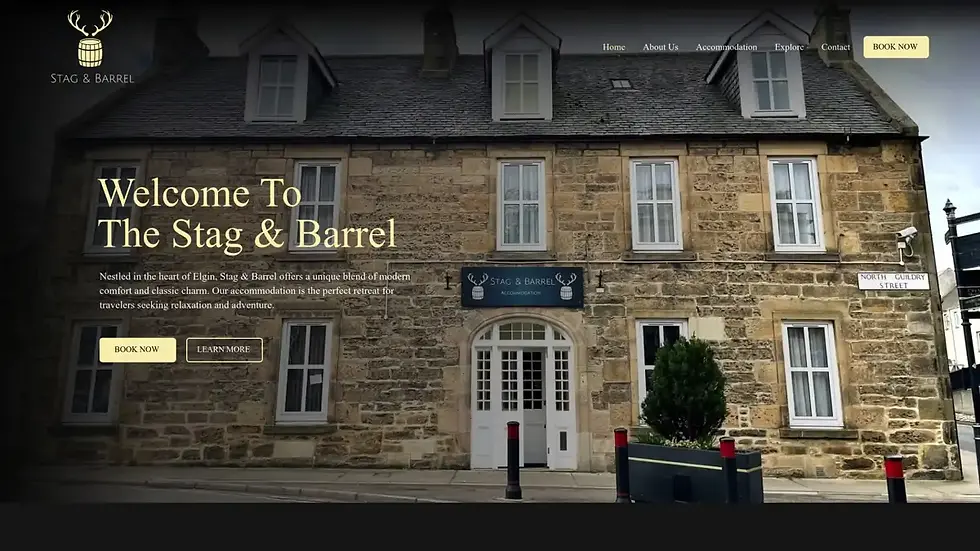
Experience these benefits first-hand by booking your next stay with us at Stag and Barrel. Our guest house embraces the traditions of authentic hospitality discussed in the article “Why Guest Houses Over Hotels – Authentic, Affordable Choice.” By choosing a guest house like ours, you not only enjoy exceptional value but also support the Elgin community. Ready for a stay that blends comfort and character with a personal touch Visit Stag and Barrel now to secure your authentic Scottish experience.
Frequently Asked Questions
What are the main differences between guest houses and hotels?
Guest houses offer a personal touch with individually decorated rooms and direct host interaction, while hotels generally provide standardised accommodations and formal service.
Are guest houses more affordable than hotels?
Yes, guest houses typically cost less than hotels for comparable quality, often including amenities like homemade breakfast that hotels charge extra for.
What unique experiences can I expect at a guest house?
At a guest house, you can look forward to personalised recommendations from your host, communal dining experiences, and a deeper connection to local culture compared to standard hotel stays.
How does staying in a guest house benefit the local community?
Staying in a guest house supports local economies by keeping profits within the community, employing local staff, and sourcing supplies from nearby businesses, contributing to more sustainable tourism practices.
Recommended


Comments